
APCTP Network School & Workshop on
Complex Condensed Matter Systems
2 0 2 6
Welcome to ANSW 2026! 😃
The APCTP Network School and Workshop on Complex Condensed Matter Systems (ANSW) 2026 is held on November 16-20, 2026, at Faculty of Mathematics and Natural Sciences (FMIPA), Universitas Indonesia
Click to jump to specific information: Overview | Scientific Program/Schedule | Invited Lecturers/Speakers | Venue | Registration | Visa, Transportation, Accommodation | Access to the Venue | List of Participants | Pictures | Organizers and Sponsors | Contact Info
💡 Overview
ANSW 2026 continues its mission as a premier combined event for graduate students, postdoctoral fellows, and early-career researchers in physics, materials science, and related fields. The program is structured to provide foundational pedagogical lectures in condensed matter physics, complex systems, and statistical physics, running parallel to a workshop component that showcases cutting-edge research and current trends through seminar-style talks. Another key feature of this event is the dedicated poster session, offering graduate students and researchers a valuable platform to present their work and engage in scientific discourse.
In addition, ANSW 2026 highlights the topics for the school and workshop, which remain focused on areas of modern research.
- Complex condensed matter systems, open quantum systems, and nonequilibrium quantum thermodynamics
- Light-matter interaction in nanostructures, quantum transport, and theoretical photonics
- Strongly correlated electronic systems, electronic structure near defects, interfaces, and surfaces
- Nonequilibrium statistical physics and soft matter
- Entanglement and dynamics in quantum matter, topological excitations
ANSW 2026 will be the seventh in the series organized by the APCTP (previously ICTP) Asian Network on Condensed Matter, Complex Systems, and Statistical Physics. Invited lecturers are active practitioners from the Network’s Nodes of various Asian countries and guest speakers from other continents. The event fosters active, high-level interaction and offers direct insights from invited experts. Finally, it also encourages collaborations across diverse domains of complex condensed matter systems.
🗓️ Scientific Program
(See also: https://bit.ly/answ2026-program-abstract-book)
Each invited lecturer will provide basically one-hour lecture, unless requested (and is willing) to give two-hour lecture. The one-hour lecture will be of an introductory graduate (or advanced undergraduate) level, focusing on analytical, computational, or experimental techniques. If given another one hour, the same lecturer can provide more advanced methods and research results while maintaining a pedagogical style. The workshop component on the two final days will cover recent scientific achievements in 15-minute or 30-minute talks. Some contributions from graduate students and early-career researchers are also possible through poster presentations. The dedicated poster session is scheduled on the second day (November 17). The best poster size for the available poster panels is A1 size (portrait). Participants are still allowed to print the A0 or A2 size although it may look either too large or too small.
Day 1 (Monday, November 16, 2026)
- 08:00 – 08:30 Registration (30 mins)
- 08:30 – 09:15 Opening Ceremony & Remarks (45 mins)
- 09:15 – 10:15 Lecture 1: Prof. Jose Perico Esguerra (NIP-UPD), “First Passage and Exploration Properties of Selected Stochastic Processes”
- 10:15 – 10:30 Coffee Break (15 mins)
- 10:30 – 11:30 Lecture 2: Dr. Jane Bernadette Denise M. Garcia (NIP-UPD), “Controlling topological defects in 3D liquid crystalline phases”
- 11:30 – 12:30 Lecture 3: Dr. Adam Badra Cahaya (UI), “Reconciling Optical Momentum in Matter through Photon Spin”
- 12:30 – 13:30 Lunch Break (1 hr)
- 13:30 – 14:30 Lecture 4: Prof. Agustinus Agung Nugroho (ITB), “Synthesis and Characterization of Quantum Materials: Weyl Properties of SrRuO3 from Prediction to Realization”
- 14:30 – 14:45 Coffee Break (15 mins)
- 14:45 – 15:45 Lecture 5: Dr. Alexey Andreanov (IBS, Korea), “The Levy Sachdev-Ye-Kitaev model”
- 15:45 – 16:00 Announcements & Daily Wrap-up (15 mins)
Day 2 (Tuesday, November 17, 2026)
- 08:45 – 09:00 Preparation & Morning Announcements (15 mins)
- 09:00 – 10:00 Lecture 6: Dr. Yeongjun Kim (IBS, Korea), “Localization in Flat Bands”
- 10:00 – 10:15 Coffee Break (15 mins)
- 10:15 – 11:15 Lecture 7: Dr. Nguyen Thi Kim Thanh (IoP VAST), “Interaction Effects on Transport, Thermoelectricity, and Noise in Weakly Coupled Charge Kondo Circuits”
- 11:15 – 12:15 Lecture 8: Dr. Vladimir P. Villegas (Mapúa Univ.), “Quantum engine and refrigeration processes in the 1D open Fermi-Hubbard model”
- 12:15 – 13:15 Lunch Break (1 hr)
- 13:15 – 14:15 Lecture 9: Prof. Tasrief Surungan (Universitas Hasanuddin), “Classical and Quantum Monte Carlo Simulation for Condensed Matter Computational Research”
- 14:15 – 14:30 Coffee Break & Poster Setup (15 mins)
- 14:30 – 16:00 Poster Session & Networking (90 mins)
Day 3 (Wednesday, November 18, 2026)
- 08:45 – 09:00 Morning Announcements (15 mins)
- 09:00 – 10:00 Lecture 10: Dr. Kitinan Pongsangangan (Mahidol Univ.), “Kinetic equation from Landau level basis: Beyond relaxation-time approximation”
- 10:00 – 10:15 Coffee Break (15 mins)
- 10:15 – 11:15 Lecture 11: Dr. Roland Cristopher Foronda Caballar (UST), “Dissipative Preparation and Control of Quantum Systems with Trapped Ultracold Atoms”
- 11:15 – 12:15 Lecture 12: Dr. Eddwi Hesky Hasdeo (BRIN), “Geometry and Light in Bloch Bands: Shift and Photon-Drag Probes of Altermagnets and Dynamical Moiré Floquet States”
- 12:15 – 13:15 Lunch Break (1 hr)
- 13:15 – 14:15 Lecture 13: Dr. Donny Dwiputra (BRIN), “Slower Is Faster: Temporal Extensivity in Quantum Battery Charging”
- 14:15 – 15:15 Lecture 14A: Dr. Areeya Chantasri (Mahidol Univ.), “Quantum measurement and open quantum system theory for quantum technology” (Part 1)
- 15:15 – 15:30 Coffee Break (15 mins)
- 15:30 – 16:30 Lecture 14B: Dr. Areeya Chantasri (Mahidol Univ.), “Quantum measurement and open quantum system theory for quantum technology” (Part 2)
- 16:30 – 17:00 Announcements & Banquet Transition (30 mins)
- 18:00 – 21:00 Banquet (Official Dinner)
Day 4 (Thursday, November 19, 2026)
- 08:30 – 08:45 Morning Announcements (15 mins)
- 08:45 – 09:45 Lecture 15: Dr. Moh. Adhib Ulil Absor (UGM), “Spin–Orbit-Coupled Systems for Spintronics: Fundamentals, Spin Textures, and Emerging Functional Materials”
- 09:45 – 10:15 Research Talk 1: Prof. Rayda Gammag (Mapúa Univ.), “Size matters: the evolution of the density of states with dimensions”
- 10:15 – 10:30 Coffee Break (15 mins)
- 10:30 – 11:00 Research Talk 2: Dr. M. Shoufie Ukhtary (BRIN), “Quantum State Transfer with Spin Chain”
- 11:00 – 11:30 Research Talk 3: Dr. Andhika Oxalion Kiswandhi (BRIN), “Quantized Thermoelectric Hall Conductivity in Straight Nodal Line Semimetal in the Quantum Limit”
- 11:30 – 12:00 Research Talk 4: Dr. Lukas Primahatva Adhitya Krisna (BRIN), “Electron-phonon limited transport in graphene/hBN moiré superlattice”
- 12:00 – 13:00 Lunch Break & Boarding Shuttle Bus (1 hr)
- 13:00 – 17:00 Cultural Excursion to Museum Nasional (Departure at 13:00 after lunch)
Day 5 (Friday, November 20, 2026)
- 08:30 – 09:30 Lecture 16: Prof. Worawat Meevasana (SUT), “Exploration of Quantum States in 2D Materials and Application in Energy Storage”
- 09:30 – 10:30 Lecture 17: Dr. Lan Nguyen Tran (VNU-HCM), “From One-Body Perturbation Theory to Quantum Computing: A Self-Consistent Framework for Electron Correlation”
- 10:30 – 10:45 Coffee Break (15 mins)
- 10:45 – 11:15 Research Talk 5: Dr. Ferry Anggoro Ardy Nugroho (UI), “Exploiting Light-Metal Nanoparticle Interactions for Sensing and Energy Applications”
- 11:15 – 13:30 Friday Prayer & Extended Lunch Break (2h15mins)
- 13:30 – 14:00 Research Talk 6: Dr. Apriadi Salim Adam (BRIN / APCTP Postdoc), “Dirac fermionic Casimir effect with field theory”
- 14:00 – 14:15 Research Talk 7: Ira Iryanti (UI), “Connecting Quantum Computing to Density Functional Theory”
- 14:15 – 14:45 Research Talk 8: Dr. Hanggara Sudrajat (BRIN), “Locating Dopants at the Atomic Scale”
- 14:45 – 15:15 Research Talk 9: Dr. Resta Agung Susilo (BRIN), “Quantum sensing at a million atmospheres using defect centers in diamond”
- 15:15 – 15:45 Closing Ceremony, Best Poster Awards & Group Photo (30 mins)
- 15:45 – 16:00 Farewell remarks
📣 Invited Lecturers and Workshop Speakers
- Alexei Andreanov (Institute for Basic Science, Korea)
- Yeongjun Kim (Institute for Basic Science, Korea)
- Apriadi Salim Adam (Asia Pacific Center for Theoretical Physics, South Korea)
- Areeya Chantasri (Mahidol University, Thailand)
- Kitinan Pongsangangan (Mahidol University, Thailand)
- Worawat Meesavana (Suranaree University of Technology, Thailand)
- Vladimir Villegas (Mapua University, Philippines)
- Rayda Gammag (Mapua University, Philippines)
- Roland Cristopher Foronda Caballar (University of Santo Tomas, Philippines)
- Jose Perico Esguerra (National Institute of Physics, University of the Philippines Diliman, Philippines)
- Jane Bernadette Denise M. Garcia (National Institute of Physics, University of the Philippines Diliman, Philippines)
- Lan Nguyen Tran (The Vietnam National University Ho Chi Minh City, Vietnam)
- Nguyen Thi Kim Thanh (Institute of Physics, Vietnam Academy of Science and Technology, Vietnam)
- Agustinus Agung Nugroho (Institut Teknologi Bandung, Indonesia)
- Moh. Adhib Ulil Absor (Universitas Gadjah Mada, Indonesia)
- Tasrief Surungan (Universitas Hasanuddin, Indonesia)
- Adam Badra Cahaya (Universitas Indonesia)
- Ferry Anggoro Ardy Nugroho (Universitas Indonesia)
- Andhika Oxallion Kiswandhi (National Research & Innovation Agency, Indonesia)
- Donny Dwiputra (National Research & Innovation Agency, Indonesia)
- Eddwi Hesky Hasdeo (National Research & Innovation Agency, Indonesia)
- Hanggara Sudrajat (National Research & Innovation Agency, Indonesia)
- M. Shoufie Ukhtary (National Research & Innovation Agency, Indonesia)
- Resta Agung Susilo (National Research & Innovation Agency, Indonesia)
📍 Venue
The School and Workshop is held at the Faculty of Mathematics and Natural Sciences (FMIPA), Universitas Indonesia (UI), Depok 16424, Indonesia.
- School & Workshop: “Aula Prof. Dr. Soemantri Brodjonegoro”, Main Hall/Auditorium of FMIPA UI.
- Poster Sessions & Breaks: Lobby Area, FMIPA Building
👤 Registration
The registration was closed on October 16th, 2026, 23:59 GMT+7.
All participants who have filled in the registration form are basically accepted (see: List of Participants) and are welcome to directly join the event with the minimum facilities of lunch meals and coffee breaks. The decisions (and invitation letters) for those who can obtain transportation and/or accommodation support have been sent individually through email (from the ANSW 2026 secretariat: answ2026@sci.ui.ac.id).
✈️ Visa, Transportation & Accommodation
Visa and Entry to Indonesia
For most ANSW 2026 participants from Southeast Asia, entering Indonesia should be straightforward. Citizens of Brunei Darussalam, Cambodia, Laos, Malaysia, Myanmar, the Philippines, Singapore, Thailand, Vietnam, and Timor-Leste currently enjoy visa-free short visits to Indonesia. For participants holding passports from these countries, no Visa on Arrival is normally required for a short visit such as attending ANSW 2026.
Participants should nevertheless make sure that:
- their passport is valid for at least six months from the date of arrival;
- they have a return or onward ticket; and
- they satisfy any other current Indonesian immigration requirements.
Participants from other countries may need a Visa on Arrival (VoA) or an electronic Visa on Arrival (e-VoA). Eligibility depends on nationality, so participants should check the latest regulations issued by the Indonesian Directorate General of Immigration before travelling. For eligible travelers, the Visa on Arrival currently costs IDR 500,000 and allows a stay of up to 30 days. It may be extended once for another 30 days. We recommend using the e-VoA system before departure whenever possible. This can reduce the time needed for immigration procedures after arriving in Indonesia.
Official e-VoA website: https://evisa.imigrasi.go.id
Eligible participants may also obtain a Visa on Arrival after arriving at Soekarno-Hatta International Airport. Follow the signs for Visa on Arrival before proceeding through immigration. International participants should normally prepare:
- a passport valid for at least six months;
- a return or onward ticket;
- accommodation information in Indonesia; and
- payment for the Visa on Arrival, where applicable.
International passengers should also complete the Indonesian All Indonesia arrival declaration before arrival. Official arrival declaration website: https://allindonesia.imigrasi.go.id
Because immigration regulations may change, participants are strongly advised to verify the requirements applicable to their own passport shortly before travelling.
Accommodation within/near Universitas Indonesia
For convenient access to the ANSW 2026 venue, we recommend staying either inside the Universitas Indonesia campus or along the nearby Margonda area. Some participants are supported to stay in one of the following guest houses/hotels:
- Wisma Makara UI (Google Maps: https://maps.app.goo.gl/SDb2RwC2pb9NAujW9)
- Guest House Pusat Studi Jepang UI (Google Maps: https://maps.app.goo.gl/4nEQbTRFs5oBvGyS6)
- Daima Suites Margonda (Google Maps: https://maps.app.goo.gl/cLzcDE9d17UFU7As6)
From Soekarno-Hatta (CGK) International Airport, the simplest option to access any of the lodging above is by taking Bluebird taxi, GrabCar, or GoCar directly and showing the maps to the drive. Travel time depends strongly on Jakarta traffic, but participants should normally allow approximately 1 to 2 hours.
For participants who prefer public transportation:
- Take the Airport Train from Soekarno-Hatta International Airport.
- Get off at Manggarai Station.
- Transfer to the KRL Commuter Line toward Bogor or Depok.
- Get off at Universitas Indonesia Station.
- From the station, continue to the hotel near the station using Grab, Gojek, a taxi, or other local transportation.
This route is considerably cheaper than taking a taxi all the way from the airport, although traveling with large luggage can make the transfers less convenient.
Getting to the ANSW 2026 Venue
The ANSW 2026 activities will take place at Aula Prof. Dr. Soemantri Brodjonegoro (Main Hall), Faculty of Mathematics and Natural Sciences (FMIPA), Universitas Indonesia (UI). The hall itself may not yet appear as a separate destination on Google Maps. Participants can therefore use the nearest mapped building in the FMIPA UI complex as their navigation destination.
Closest mapped building to the ANSW 2026 venue:
🔗 https://maps.app.goo.gl/wuDidP7shT7NAgwy9
For speakers/participants who are arranged to stay in Wisma Makara, there are some university shuttle buses (yellow color) that regularly operate around the landmarks of UI (including Wisma Makara). One of student organizers (Mr. Solihin) will guide the speakers/participants in the morning of November 16, 2026 (around 7:30) to go together to the venue by the shuttle bus. However, if you prefer going to the venue on foot please allow approximately 30-40 minutes for walking to the FMIPA area (check the Google Maps).
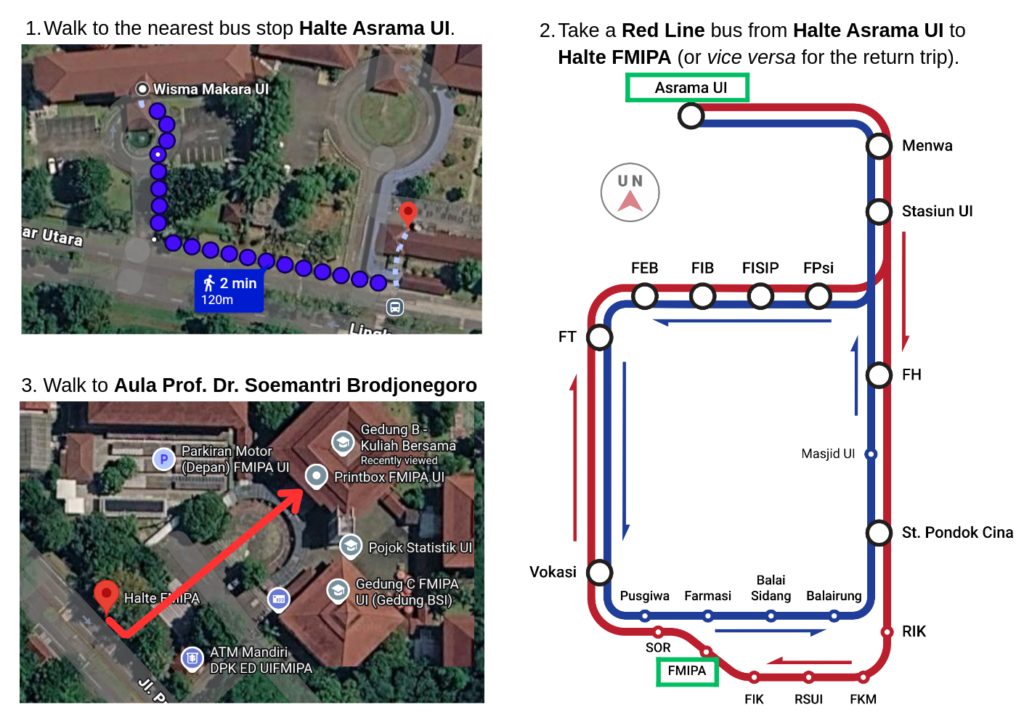
Once you arrive near the mapped building, find the ANSW 2026 signs or ask anyone around for Aula Prof. Dr. Soemantri Brodjonegoro.
For those who are arranged to stay in Guest House Pusat Studi Jepang UI or Daima Suites Margonda, we can only recommend going on foot as the venue is not too far from the lodging (15-20 minutes by walking). Please study the maps in advance.
👥 List of Participants
🔗 https://bit.ly/answ2026-participants
The list of registered participants (including all presenters) can be checked from the above sheets.
📸 Pictures
Gallery links and official event photographs will be made available in this section after the conclusion of the ANSW 2026 program.
🌐 Organizers
Steering Committee
- Cristine Villagonzalo (University of the Philippines Diliman, The Philippines)
- Paul Pearce (University of Melbourne, Australia)
- Sergej Flach (Institute for Basic Science, Korea)
- Ki-Seok Kim (APCTP and Pohang University of Science and Technology, Korea)
- Muhammad Aziz Majidi (Universitas Indonesia) – Chair of the local organizer
Local Organizing Committee
- Universitas Indonesia (UI): Muhammad Aziz Majidi (chair), Adam Badra Cahaya, Seno Aji, Dede Djuhana
- National Research and Innovation Agency (BRIN): Ahmad Ridwan Tresna Nugraha (secretary), Eddwi Hesky Hasdeo (program director), Edi Suprayoga, M Shoufie Ukhtary, Sasfan Arman Wella (Media), Donny Dwiputra, Mohammad Hamzah Fauzi, Zulkaida Akbar (fundraising)
- Institut Teknologi Bandung (ITB): Agustinus Agung Nugroho
🤝 Sponsorship
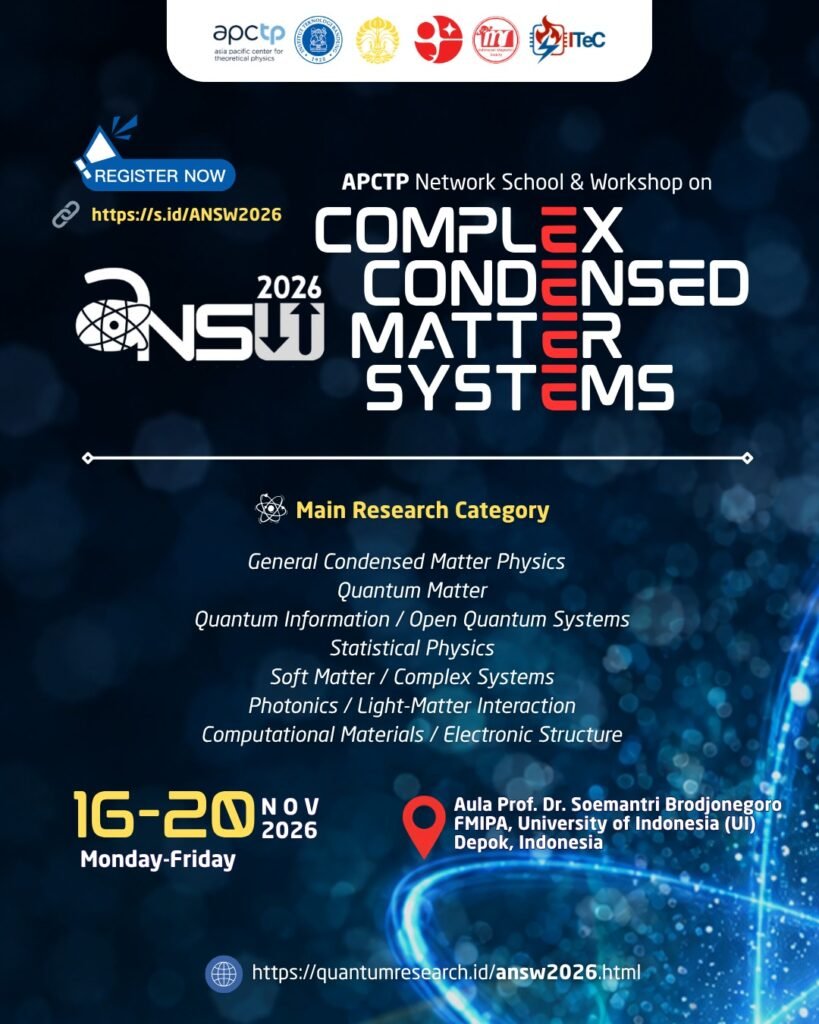
So far, the event is financially sponsored by the Asia Pacific Center for Theoretical Physics (APCTP), Universitas Indonesia (UI), Indonesian Thermoelectric Community (ITeC), and some individuals (donations). However, we remain completely open to any kind of additional sponsorship. Any logos of our sponsors/supporters can be put in the advertisement like the poster below.
📧 Contact Information
Any questions? Please send emails to: answ2026@sci.ui.ac.id